February 23, 2026|ו' אדר ה' אלפים תשפ"ו The Greatest Threat Facing the Jewish People Isn't Antisemitism
Print Article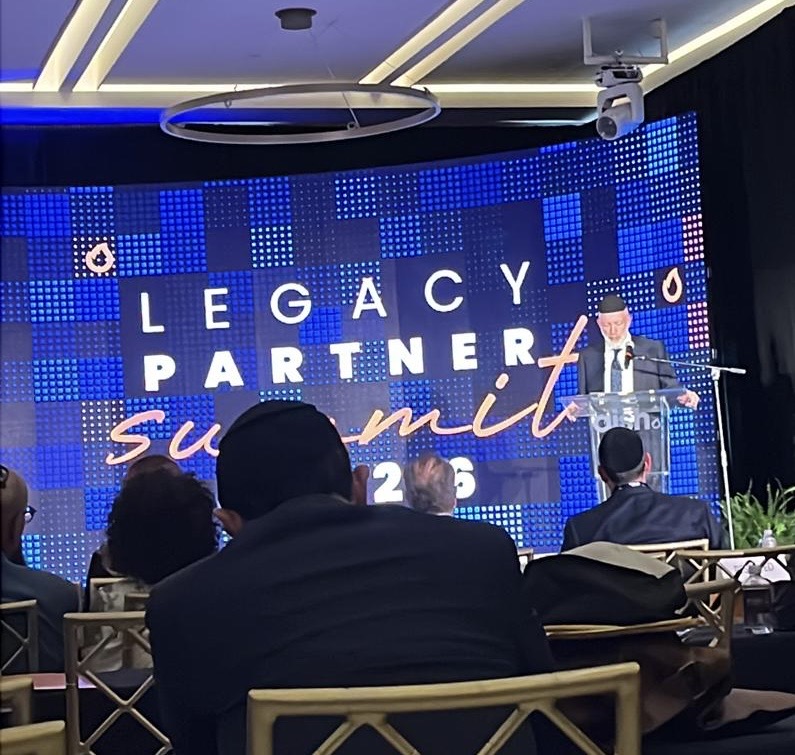

Based on a talk I delivered at the Aish Legacy Summit in Bal Harbour on February 11, 2026
I want to begin by acknowledging something very important: The people who are here are not professionals. You are not obligated. You took time out of your busy schedules, set aside resources, and made it a priority to be here, to care, and to engage in a serious conversation because you care about Klal Yisrael, the future of the Jewish people.
In my lifetime, this is the most critical juncture to be having this conversation. With so many enemies from without, with so many threats that we face, and with so many concerns about our future, there has never been a more important time for all of us to shift our focus to the Jewish people. That is what I want to talk about in my limited time with you. What it means and looks like to care about Klal Yisrael.
One of the modules and incredible tools created by Aish and shared today focuses on antisemitism. That makes sense, because antisemitism has become the catchword of our age and tragically perhaps the word of our generation. Antisemitism is on the rise and everyone is exploring and suggesting ways to confront it.
I have only gratitude for Bob Kraft for putting his money toward confronting Jew hatred, and I don’t want to be critical of him or the commercial he commissioned that was shown during the Super Bowl. But I want to challenge us to think about this differently. Not focused on what may be wrong with the commercial but what you would have done with that money instead. If you had the resources to buy thirty seconds to be shown during the Super Bowl, if you could put a message in front of a hundred million people, what would it be? What message would best advocate for the Jewish people and our future? Would you focus on being a minority, on bullying, on hate, or the Holocaust? What would you choose?
If I had those thirty seconds, if I could put a billboard on every highway and broadcast one message everywhere, it would be rooted in this principle: There is a danger and a threat far more pernicious, far more penetrative, and far more destructive to our people than antisemitism, and it is called assimilation. If all the antisemites on the planet gathered together at a magnificent conference with top-tier branding and coordination, they could not do the damage to us that we are doing to ourselves. They could not cause our disappearance at the pace we are causing it on our own. Until the middle of the twentieth century, intermarriage never rose above three percent. In 1964 it rose to seven percent. Today, among secular Jews in the United States, the intermarriage rate is seventy percent. In Europe it is fifty percent.
Antisemitism is dangerous and of course we must confront it. We need leaders who will stand with our people and with Israel. We need legislation to protect Jewish students on campus and security funding for our institutions. I am not minimizing it in any way. But if antisemitism becomes the focus of everything we talk about, if it dominates every gathering and every conversation, we allow ourselves to be distracted.
The truth is that the only people who really want to talk about antisemitism all the time are antisemites. It fuels them, elevates them, and amplifies their voices. It distracts us from the conversation we should be having, which is not about them, but about us.
The real conversation the Jewish people must be having is who we are, why we are here, and what difference we are meant to make. Our enemies want us to slow down, to pull over, and to complain about the obstacles they put in our way. But we need to step on the gas, because there is too much work to do to repair and improve this world. Assimilation and antisemitism are different threats, but our response to both is the same. It is not endless discussion of either one. It is the promotion and empowerment of Jewish pride, Jewish practice, and Jewish passion. It is helping Jews of all ages reach into the Jewish soul inside them and ask why the world is obsessed with us and threatened by us. If they want to hate us for being Jews, then we need to find out and shout out what it means to be a Jew.
The Midrash (Bamidbar Rabbah 17:6) gives a metaphor of a person drowning at sea, flailing as the waves threaten to sweep them away. A rope is thrown to them, and they are told that if they hold on, they will survive, but if they let go, they will disappear. The Midrash teaches that tzitzis are that rope, and not only tzitzis, but all mitzvos. For thirty-three hundred years we have held the Tree of Life. עץ חיים היא למחזיקים בה.
We are living in the most prosperous and comfortable era in human history and yet people are more anxious, depressed, and unhappy than ever. Consumerism promised happiness and delivered emptiness. We have the answer. We have been living it for millennia.
The winds and waves are sweeping our people away. Let’s throw the life preservers of Torah, Mitzvos, and uniquely Jewish meaning. Let’s extend the branch of eitz chaim hi for others to hold on to. And so many are desperate to, even if they can’t put it into words.
A recent Harvard study found that over half of young adults (58%) said they had experienced little or no purpose or meaning in their lives in the previous month. In addition, half of young people said that their mental health was negatively influenced by “not knowing what to do with my life.” Those belonging to a religion were more likely to report meaning or purpose. Young adults who said they had little or no purpose or meaning reported more than twice the rates of anxiety or depression than young adults who did feel purpose and meaning (54% vs. 25%, respectively).
At Har Sinai, Hashem told us that we are a mamleches kohanim v’goy kadosh. We are meant to live lives of responsibility, not entitlement. We are meant to wake up each morning asking what our mission is, what our responsibility is, and how we can make the world better today. That question, the one the Ramchal begins Mesillas Yesharim with, mah chovas ha’adam b’olamo, what is your duty in your world, is the foundation of a meaningful life and it is our gift to the world. We are meant to bring light instead of darkness, kindness instead of cruelty, justice instead of corruption, discipline instead of impulse. Judaism is a platform to be a giver, not a taker, to feel a sense of duty, responsibility, not rights and entitlements, and we are meant to teach that to the world.
Haman described the Jewish people as “yeshnu,” asleep, and he was right. We were fragmented and distracted. Mordechai refused to bow, not because he lacked a Halachic justification, but because he understood the moment demanded strength, not accommodation. He stood tall, proud, and unapologetic. And that is why the Megillah describes him as Ish Yehudi haya b’Shushan habirah. One Jew. Not because there were no others, but because he embodied what it meant to be a Jew. That is our calling in this moment.
What happens when Jews stand up for ourselves, when we stand tall and proud and practicing and refuse to bow down physically or spiritually? By the end of the story, the Megillah tells “fear of the Jew had fallen on them and so no man could stand up against them.” Why? Because Mordechai, the proud, unashamed, unapologetic and fearless Jew, “earned the respect of his multitude of brothers, he sought the good of his people and spoke for the welfare of the next generation.”
If I had thirty seconds to broadcast a message to the world, I wouldn’t address the one hundred million non-Jews watching, I would direct my commercial to the Jewish people and tell them – learn about where you come from, who you are part of, know our history, the difference we have made and the destiny we are yet to make. Know the meaning it will bring to your life and with it the happiness and purpose.
I would tell Jews everywhere to know where they come from, to be proud of who they are, and I would tell young people in particular to remember that they are not eighteen or nineteen years old. They are three-thousand, three-hundred years old. Carry that DNA. Embrace that destiny. Stand tall. Practice proudly. Partner with Hashem in repairing His world. And then I would give Jews the tools to do it. I would advertise publicly that any Jew willing to put up a mezuzah, we will send them one. Any Jew willing to wear a kippah, put on tefillin, light Shabbos candles, we will send it to you with a guide on how to do it and an invitation to learn more. Yes, we need to ensure young people on their campuses are safe but we also, as importantly, need to empower them spiritually with anything else that helps them step out of hiding and into the light.
This happens one Jew at a time. One conversation. One invitation. One moment when someone casually asks about Passover or matzah and is really asking to be remembered, to be included, to feel connected. You are not alone in this mission. You have partners like Aish, equipping every Jew with the tools to succeed.
May the Ribbono Shel Olam give us the strength, courage, clarity, and conviction to take responsibility for our people, to be the ish Yehudi of our generation, and to step on the gas toward our destiny together.