December 30, 2025|י' טבת ה' אלפים תשפ"ו What Pushing In Your Chair Says About You
Print Article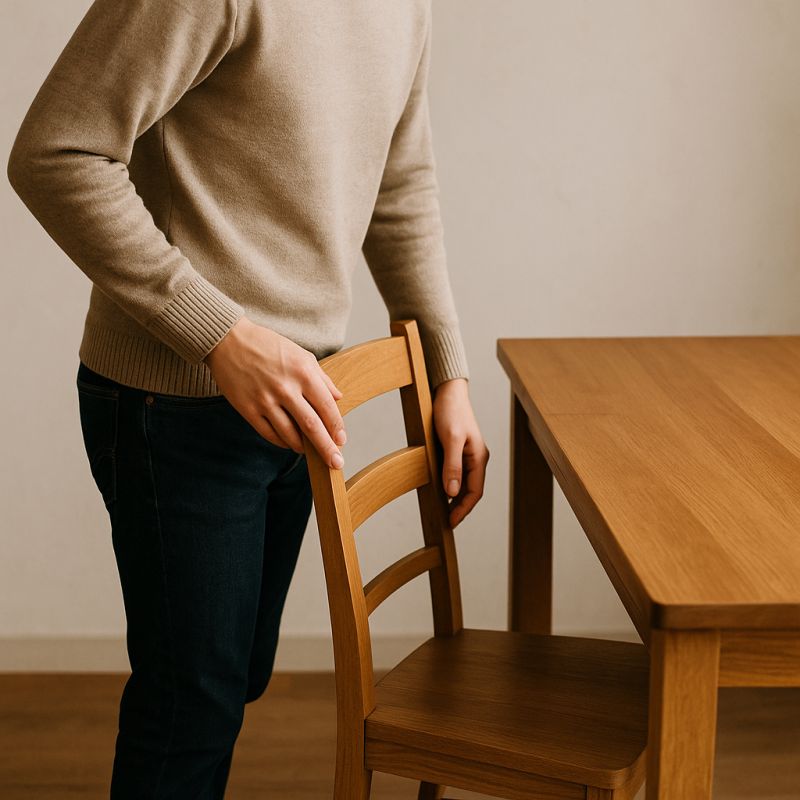
My children know one of my little pet peeves is not a big offence, not something worthy of public rebuke, but a small thing I see everywhere: when a person gets up from a table and does not push the chair back in. You see it in shul and a beis medrash, around the Shabbos table, in a boardroom or a restaurant. Just a chair left askew. It is easy to dismiss it as trivial, and yet it represents something more.
We often underestimate the power of small acts. Throughout shas, our rabbis refer to the head of the Jewish community as Reish Sidra, the head of order. He attains that position specifically because he is attentive to the importance of small acts. He knows that seder, order, is the scaffolding of a disciplined life.
In his Daas Torah, Rabbi Yerucham Levovitz zt”l writes about how the Alter of Kelm was famed for his rigorous emphasis on seder, mussar, and disciplined excellence. He writes, “I was educated in Kelm, a place where they were extremely meticulous about order. The Alter of Kelm, of blessed memory, would become upset if someone did not put their chair back precisely in its place, as though they had committed an act equivalent to desecrating Shabbos.”
The Alter did not view order as an aesthetic. He saw it as a religious imperative. Put another way, chaos is spiritual drift and order is spiritual anchoring.
The Alter taught that seder is like the string in a pearl necklace. The pearls are what we treasure, the Torah, mitzvos, kindness, family, community. But without the string, the pearls scatter, beautiful yet valueless. Rav Yeruchem inherited a garment the Alter wore for 30 years and it was taken care of so meticulously, it was left after his death as if it was brand new. It was not because the Alter was particular for its own sake, but because care and respect for the world around him were reflections of inner order. When he put on his hat, it was not tilted to the right or left or sitting casually on the back of his head. It was perfectly aligned. This was not compulsive behavior. This was a deeply felt spiritual discipline.
And now, what Torah always knew, science is beginning to affirm. A recent study reports that people who push their chair in tend to exhibit what researchers call social mindfulness and self- control. These acts reflect awareness of others, consideration, discipline, and responsibility even when no one is watching.
The article explains that a person who pushes in their chair is:
• Attentive to their surroundings.
• Conscious of how their actions affect others.
• Habitually considerate, acting with kindness without needing to think about it.
• Naturally disciplined, showing care through consistent small behaviors.
• Respectful, recognizing shared spaces and the people who use them.
• Unselfish, leaving things better for the next person.
• Mindful, living with awareness rather than carelessness.
In other words, this tiny gesture reflects a broader pattern of character. The way a person treats a chair is often how they treat the world.
A simple pause before leaving a table, placing the chair neatly, says: I see the world as something sacred, worthy of care. It reveals a person who thinks not just about self but about others who will come after.
And here is the deeper lesson: discipline begets freedom. A person who masters small actions gains mastery over larger ones. When you manage your time with order, you find you have more time. When you manage money with discipline, you find you have more resources. When you bring seder to your Torah learning and mitzvah observance, you unlock deeper growth and fulfillment.
This is not about perfectionism. It is about intentionality. The discipline to sit down and learn consistently. The discipline to serve Hashem when it is hard. The discipline to be reliable and present for another human being.
This is why I often tell my children that when they begin to think about dating and building a life with someone, they should not only look at grand gestures, eloquent words, or impressive résumés. They should watch the small things. Does this person say thank you? Do they notice when someone is uncomfortable? Do they treat waiters, teachers, siblings, and strangers with quiet respect? And yes — do they push in their chair. Not because the chair matters, but because derech eretz matters. Because the way a person handles the unimportant is often the truest window into how they will handle what is important. A home is not built on dramatic moments alone; it is built on thousands of tiny acts of consideration, patience, and care. Choosing a life partner is ultimately choosing the character you want to live with, grow with, and be shaped by. And character is most honestly revealed not in what is proclaimed, but in what is practiced when no one is watching.
So the next time you rise from the table, do not rush out. Pause for just a second. Turn back. Push your chair in. Let that act be a microcosm of your life: careful, considerate, and connected to something greater than yourself.