March 24, 2026|ו' ניסן ה' אלפים תשפ"ו Missiles, Sirens, and Responsibility From Afar
Print Article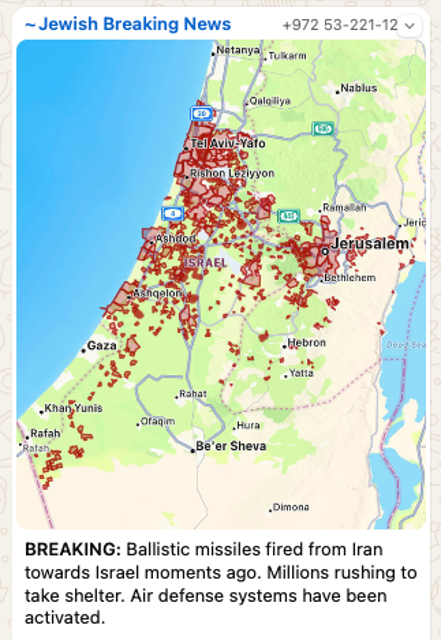
This news alert comes regularly: ballistic missiles fired from Iran toward Israel. Within moments, millions of Israelis rush to shelters as air defense systems activate across the country. Sirens blare, families grab their children, drivers pull over and run to the side of the road, and entire cities pause as people search for safety.
For the last three weeks, we outside Israel have watched these alerts come regularly, several times a day and night. They have come so regularly that our phone dings or vibrates, we give a glance, and then usually go right back to whatever we were doing. But to be clear, such an alert is not normal. It can never become normal. No matter how often they come or how used to them we may become, we must remain maladjusted to such an alert and stay aware and outraged by how not normal they are.
The human spirit adapts quickly. When sirens happen often enough, when alerts interrupt life again and again, there is a life-threatening danger to those running to shelters. But there is also a danger that we begin to treat this as routine. Missiles flying toward civilian populations can never be routine. Running with children to a bomb shelter can never be normal. The fact that Israelis have developed the strength and resilience to endure it does not make it acceptable or ordinary.
Here in America, we will never receive such an alert. We do not have reinforced safe rooms in our homes. Our children do not grow up practicing how quickly they can reach a shelter. We do not interrupt dinner, school, minyan, or sleep to run for our lives. We do not calculate if we have time between sirens for basic things like showering. We live with a level of security that we often take for granted. That contrast should humble us and it should awaken within us a deeper sense of responsibility to those who do not have that luxury.
After October 7, the Jewish community outside of Israel responded in extraordinary ways. American Jews rallied in the streets and in public squares. Communities organized missions to Israel. We packed duffel bags with supplies, sent equipment and clothing, wrote letters to soldiers we had never met, and added Tehillim to our daily prayers. Many of us reoriented our schedules, our conversations, and even our emotional lives around the reality that Israel was at war.
Now Israel finds itself at war again. True, there are overt and explicit miracles happening each day, and we are fortunately not needing to pray for the safety of any hostages, but that doesn’t mean this isn’t an incredibly dangerous moment for our people. Millions of our brothers and sisters are effectively on the front line because every inch of the country is within reach of missiles. At the same time, heroic soldiers are defending the nation across multiple fronts: in Lebanon, in Gaza, in Syria, and in the skies over Iran. The entire nation carries the burden together.
At this moment, many of us outside Israel feel a certain helplessness. We cannot easily travel there right now, and it does not seem that there is an urgent call for the kinds of physical supplies we mobilized before. But that does not mean our lives can simply continue as if nothing is happening. Our brothers and sisters may not expect us to stop living our lives, but our lives cannot proceed with indifference.
One small but meaningful step is something we can all do immediately: Set an alert for news about the sirens in Israel. Each time you see that Israelis are running to shelters, let that become a spiritual alarm for you. Pause whatever you are doing and say one paragraph of Tehillim. One chapter. One short prayer. If they are running to shelters, we can run to prayer. In that way their moment of fear becomes our moment of connection with God on their behalf.
And along with prayer, we can reach out in simple human ways. Each time there is an alert, send a message to someone you know in Israel. A friend, a relative, a former neighbor, a classmate. Just a short text: “Thinking of you.” “Praying for your safety.” “Stay safe.” When they run in and out of shelters, they should feel that Jews around the world are thinking about them in that very moment.
There is another responsibility we carry as well. We must be careful with our language and with what we post publicly. No one in Israel expects Jews in America to stop living, to cancel family celebrations, or to refrain from preparing for Pesach. Life must continue. But there is a reasonable expectation that we will not be tone deaf.
Don’t talk about being “rescued” or “stuck” in reference the place that is home to millions of our people, the homeland we should all be working to move to, and from which those who live there have nowhere else to go.
The Torah teaches the prohibition of ona’as devarim, the responsibility to avoid causing pain through our words. In our time that principle extends beyond speech to the images we share and the complaints we broadcast. Everyone has challenges. Life is complicated everywhere. But at moments like this we must place our frustrations in context. If a difficulty we are facing is not life-or-death, if it does not involve running to shelter from ballistic missiles, then perhaps it does not need to be shared widely or posted publicly right now.
And for many in our own communities, this is not distant news. Around us are friends, neighbors, and congregants whose children and grandchildren live in Israel. Some have sons or daughters serving in the army. Others have grandchildren who run to shelters in the middle of the night. Their lives are turned upside down by this war in ways we may not fully see from the outside. Even as they come to work, attend Shul, or sit at our Shabbos tables, their hearts are thousands of miles away, following every alert and every update. For someone whose child is sleeping near a shelter or whose grandson is serving near the border, life is not proceeding normally at all. Acknowledge that and ask how their family is doing.
Our brothers and sisters in Israel are living through something that no society should ever have to endure. Their resilience is extraordinary, their courage inspiring. But we must never allow their reality to become something we treat as ordinary.
Missiles targeting civilians is not normal. Running to shelters is not normal. Living under that threat is not normal.
And even from thousands of miles away, with love in our hearts, loyalty in our prayers, and sensitivity to those around us who are carrying this burden personally, we must remind ourselves of that truth again and again.