April 14, 2026|כ"ז ניסן ה' אלפים תשפ"ו Are You Holding Your Phone or Is It Holding You? Our 30-Day Challenge to Reclaim Your Life
Print Article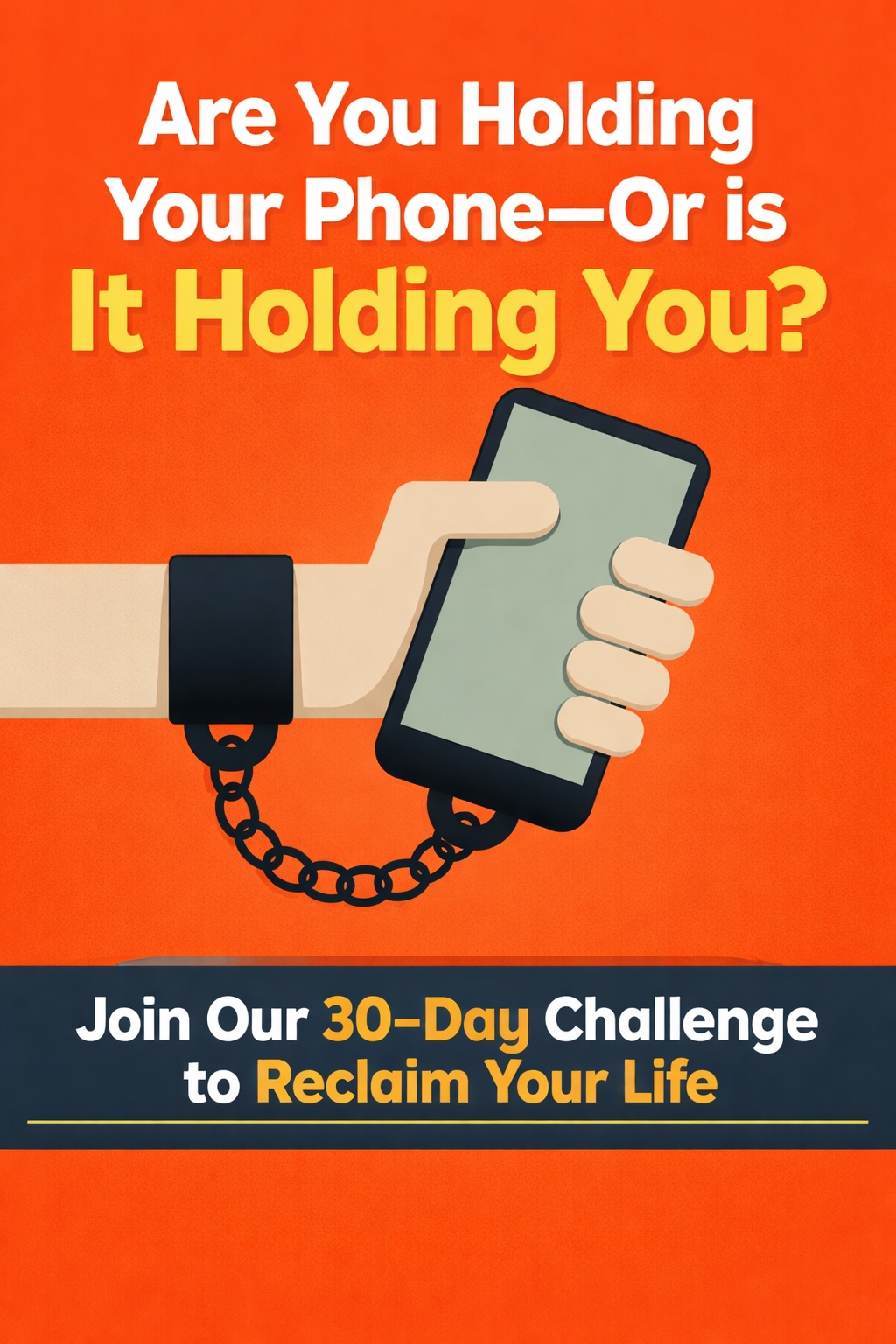
The stories emerging today are nothing short of startling. In a recent report, individuals described as “screenmaxxers” openly admit to spending virtually every waking hour on their phones: watching, scrolling, messaging, and consuming without pause. One person shared that they are doing at least three things at once on their device at all times, while another acknowledged having no plans to cut back despite recognizing the toll.
What once sounded extreme is quietly becoming normal. A life mediated almost entirely through a screen is no longer an outlier. It is a direction in which many find themselves and to which many are drifting.
Have you ever found yourself on your phone, endlessly watching, adding things to your cart, or scrolling without really thinking, knowing you should stop, but feeling like you simply cannot? It is that pull, that urgent need, that compulsion that keeps your fingers moving even when your mind is saying enough. You put your phone down for a moment, but somehow it is back in your hand before you know it. You tell yourself you will turn off the screen, step away, or stop, and yet the cycle keeps going. Are you making choices, or are things just happening to you? Is time passing in a way that leaves you feeling bad, ashamed, guilty, not proud of how you lived those hours? You want to stop. It is not who you want to be. And yet somehow, you cannot break out.
This is not laziness or a simple lack of willpower. It is something deeper, an impulse, a kind of invisible tether that grabs hold of our attention and refuses to let go, and chances are most of us feel it every single day of the week (except for one).
For a long time, we comforted ourselves with the belief that this was a problem of the young. Teenagers and college students were the ones we worried about. But recent reporting has made clear that this is not true. Baby boomers are among the biggest culprits, spending hours upon hours glued to their devices, caught in the same loops of scrolling, clicking, and consuming. This is not a generational issue. It is a human one.
Why is our generation especially vulnerable? In previous generations, addictions required effort. A person had to go somewhere to get their need, to obtain something, make a conscious decision. Today, our addictions live in our pocket. They are always with us, always accessible, always calling. Technology companies deliberately design products to be addictive, with endless scrolling, constant notifications, and variable rewards that function—and literally have chemical effects on our brains—like slot machines. They are competing for one thing, your attention, because attention is the most valuable resource in the world today.
In the beginning of our Parsha, the Torah says: “This is the law of the Metzorah on the day of his purification and he shall be brought to the Kohen.” Interestingly, when describing the purification of the Nazir, the Torah uses very similar language, but with an important difference. “This is the law of the Nazir: On the day his abstinence is completed, he shall bring himself to the entrance of the Tent of Meeting.” Rav Yeruchem Levovitz, the great Mashgiach of the Mir, asks, why the difference? Why with the Metzorah does it say “He is brought to the Kohen” and yet with the Nazir it says he brings himself?
Says Rav Yeruchem there is a fundamental difference between the Nazir and the Metzorah. A Nazir is in charge of himself and a Metzorah is subject to other forces that are in charge of him. The Nazir willingly took a vow and willingly subject himself to the process. The Metzorah is in front of the Kohen because he was brought there, compelled by powers and powerful temptations he could not withstand.
The question for us is simple and uncomfortable. Are we bringing ourselves to our choices, or are we being brought by our devices? When we feel, “I wish I could stop but I cannot,” that is the language of being carried. That is not freedom.
Every person must ask themselves honestly, what controls me? Is it my phone, my habits, my cravings? Breaking addiction requires more than willpower. It requires rebuilding a life of meaning. Real freedom begins with awareness, with recognizing what controls us clearly and honestly. It continues with removing triggers, with being willing to change our environment and create boundaries that protect us. And it hinges on replacing the dopamine, because we cannot simply remove without replacing. The urge to escape, to numb, to distract is real, but instead of feeding it with endless scrolling, we must redirect it toward reading, learning, connecting, and helping. We are not meant to simply avoid distraction. We are meant to lean into meaning.
That is why I want to invite you to something powerful. Beginning Monday, April 20th, we will be hosting a 30-day technology challenge designed to help you reset your relationship with your phone and reclaim your attention. Each day you will receive a small, simple, actionable challenge that builds self-control, sharpens awareness of your habits, and gradually loosens the grip of technology on your life. This is a joint project of Guard Your Eyes and Semichas Chaver Program, built on the idea that small daily steps, taken consistently and together, can create real and lasting change, with weekly incentives and grand prizes to keep you motivated along the way.
By the end of 30 days, you will develop a healthier and more intentional relationship with technology. You will experience greater focus, greater confidence, and a stronger sense of kedusha that carries into your everyday life.
Join the challenge at rabbiefremgoldberg.org/challenge and take the first step toward becoming truly free.